

For residential doors, door handle height is generally between 90 cm and 105 cm from the finished floor. When it comes to accessibility or commercial use, stricter criteria are required, with reference ranges such as 865 mm to 1,220 mm or 900 mm to 1,300 mm, depending on the context and type of layout.
In Montreal, this detail seems simple until the day the door doesn’t close properly, tires the wrist, or triggers a complaint in a rental building. Between the plexes of the Plateau Mont-Royal, the old houses of Westmount, the shops of Saint-Léonard and the newer condos of Anjou, the right height is never just a question of aesthetics.
In the trade, we often see the same mistake. Someone chooses a beautiful handle, sometimes a ball model still installed on an old door, then installs it “by eye”. The result works on paper, but not in everyday use. The hand forces, the bolt misaligns, and the door becomes unpleasant to use for children, the elderly or someone in a wheelchair.
As a Montreal locksmith serving French and English-speaking customers for over 20 years, I can tell you one thing. A well-placed handle is rarely noticed. A badly placed handle, on the other hand, is felt every day.
Why is the height of a door handle so important?
In a Plateau Mont-Royal apartment, a handle that’s too low may seem acceptable during installation. After a few weeks, the tenant tells you that he has to break his movement to open the door, especially with bags, a stroller or an already busy arm.
In a Westmount home, the opposite is often true. On an older, taller and heavier door, a handle installed without regard for actual use gives an unnatural gesture, then you start compensating with your shoulder or pulling at an angle. This is where mechanical wear begins.
Comfort comes before hardware
Door handle height affects three things at once:
- The natural gesture. The hand should fall easily onto the handle, without excessive flexion of the trunk or unnecessary elevation of the arm.
- True ergonomics. A good rating is just as helpful for an able-bodied adult as it is for a senior citizen, an accompanied child or a person with limited prehension.
- Door life. Incorrect positioning often creates oblique stress on the lock, spring, square and sometimes even the hinges.
A door can be solid, well-barred and expensive. If the hand works poorly at every opening, the installation is not successful.
In the multi-unit buildings of Ahuntsic or Montréal-Nord, this is not theoretical. A misplaced handle ends up generating repeated service calls. We replace the spring, adjust the bolt, grease the lock, but sometimes the original cause remains the same. The control is simply not at the right height for the job.
What’s working in the field in Montreal
Montreal’s buildings impose very concrete compromises:
- In the old. Frames are not always square, and doors may have been cut or raised after several renovations.
- In the rental market. You need to think about a variety of users, not just the current owner.
- In the commercial sector. Comfort must coexist with conformity, quick exit and solidity.
On common doors, the handle never works alone. Door closers, weatherstripping, bolts and sometimes access control completely change the feeling of opening. That’s why a discussion of height quickly becomes a discussion of safety, especially in escape routes subject to emergency exit regulations in Quebec.
Standard residential and commercial heights
For a house or condo in LaSalle, the most common practical range remains 90 cm to 105 cm from the finished floor. This is the zone that, in most cases, gives a fluid gesture for a standing adult without making the handle unnecessarily high.
In commercial applications, we can’t be satisfied with a “carpenter’s standard”. For buildings in Quebec, the issue is not just height, but the combination of height, clearance and effort, with accessibility references recommending a control between 900 and 1,300 mm, minimal opening effort and a lever-type handle rather than a ball, as explained in this guide on PMR handles and their installation.
Residential versus commercial
In residential applications, the objective is often simple. The handle has to be easy to grip, the lock has to work without forcing, and the door has to be visually attractive.
In the commercial sector, use is more demanding. A clinic entrance door in Anjou, an office door in Saint-Léonard or a corridor door in a rental building are subject to more cycles, more traction, more different users.
| Building type | Recommended height (from finished floor) | Common handle types |
|---|---|---|
| Standard residential | 90 cm to 105 cm | Lever or knob depending on door |
| Buildings with accessibility requirements in Quebec | 900 mm to 1,300 mm | Lever handle |
| Canadian reference in accessible design | 865 mm to 1,220 mm | Accessible actuating hardware |
| Sliding door | 90 cm to 105 cm | Recessed handle or adapted pull |
What we choose in practice
In a home, I almost always prefer the lever. Not because it’s “more modern”, but because it’s more forgiving of busy hands, stiff fingers in winter and quick movements.
In commercial applications, Dorex, Corbin Russwin, LCN or Assa Abloy packages make sense when the door has to withstand serious daily use. On an exterior door, the height must also remain consistent with the pull, closer and latch. If you’re comparing options for a residential or mixed-use entrance, also look at the criteria for exterior door handles adapted to the climate and use.
Workshop rule
If the handle is correctly positioned but the door still requires a sudden movement, the problem is no longer height alone. You need to check the strength of the mechanism, the latch and the pressure of the weatherstripping.
Understanding PMR accessibility standards in Quebec
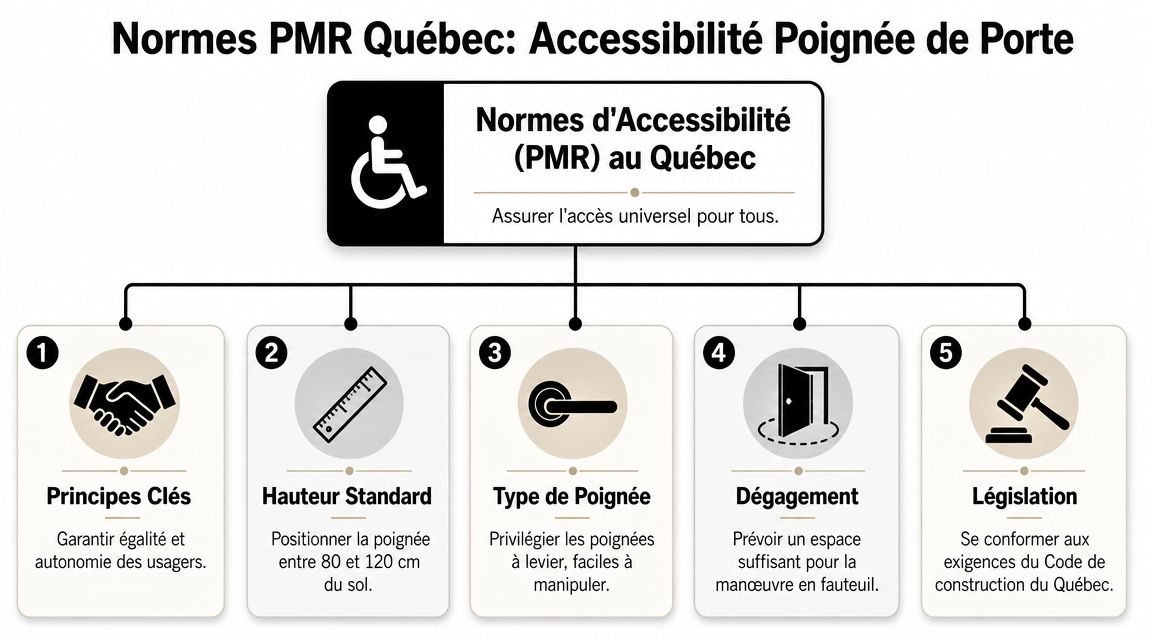
When it comes to accessibility in Quebec, door handle height isn’t a matter of “gut feeling”. In Canada, the CSA B651 standard requires that operating hardware be placed between 865 mm and 1,220 mm from the finished floor. This 355 mm range is in keeping with the logic of universal accessibility, and this practice has been reinforced in building codes since the 1990s, as recalled in this article on the Canadian standard and its applications.
What compliance means on a real door
In a building in Ahuntsic or LaSalle, compliance isn’t just a matter of reading a measurement on a tape. You have to look at the whole chain:
- Reach. A seated person must be able to reach the control without excessive movement.
- Clearance. Accessibility sources remind us that the handle must be kept clear of obstacles by more than 40 cm, and the lock by more than 30 cm, according to this reminder of clearance and daily use constraints.
- The type of grip. The lever is preferable to the ball because it limits wrist rotation.
- Real effort. A handle at the right height that requires too much force is still a poor installation.
This point is often misunderstood. You measure the handle, think you’re doing the right thing, and then forget that the door still offers too much resistance because of the spring, bolt or seal.
Common mistakes
In Montreal’s older buildings, I see three in particular:
- The handle is within an acceptable range, but the lock forces. The person has to press, turn and pull at the same time.
- The lever is good, but the wall or frame blocks the movement of the hand.
- The door has been partially renovated. New flooring, old hardware, old door closer. The final measurement is no longer as originally planned.
An accessible door is not a door that’s “just about reachable”. It’s a door that can be operated without pain, without twisting the wrist or struggling against the mechanism.
For a building manager, this nuance counts for a lot. An accessibility complaint is not just about a number. It stems from impossible or painful daily use.
Why equipment counts as much as ratings
Even with good height, mediocre material ruins the result. On common accesses, I often steer towards a coherent combination:
- High-performance locks like Medeco or Abloy when security and durability come first
- LCN or Dorex door closers when you need to control closing without making opening a painful effort
- Well-adjusted access control if the common door is to remain easy to operate for all users
This is exactly the kind of balance you’ll find in door access control system projects for buildings and businesses. An accessible installation is never an isolated piece. It’s a well-tuned whole.
How to correctly measure the height of your handle
Good measurement always starts with the finished floor. Not the subfloor, not the raw concrete, not the old level before ceramic or hardwood.
On an already installed door, we measure to the center of the handle, i.e. the axis of rotation or the square, depending on the model. Many people measure the top of the plate or the bottom of the lever. This distorts everything.
The simple on-site method

Take a few minutes and do it like a clean job site:
- Clear the area. Mats, boots, movable bumpers or objects that obscure the threshold.
- Locate the finished floor level. If there’s a transition between two floor coverings, select the main use side.
- Place the ribbon on the floor. Keep it vertical against the door.
- Read the measurement at the exact center of the handle. Not at the top of the lever.
- Take note of the rating if you are comparing several doors in a duplex, a business or a shared corridor.
To visualize the gesture, here’s a useful video example before getting out the drill or ordering new hardware:
Time-consuming mistakes
The most common are trivial:
- Measure before the final coating. Once the floor has been laid, the alignment changes.
- Take the wrong point. The decorative plate is not the reference.
- Forget actual use. A well-measured but poorly chosen handle remains uncomfortable.
For renovations in Montréal-Nord or Saint-Léonard, I always add an extra check. I open and close the door several times after taking the measurements. If the hand doesn’t slide properly, if the bolt catches or if the lever doesn’t return properly, the number alone isn’t enough.
For an entrance that must also withstand cold, damp and freeze cycles, it’s worth comparing the best exterior door handle options according to the type of use.
Exceptions and special cases to be aware of
Not all doors accept the same logic. In Montreal, this is particularly true once you move away from the classic interior door.
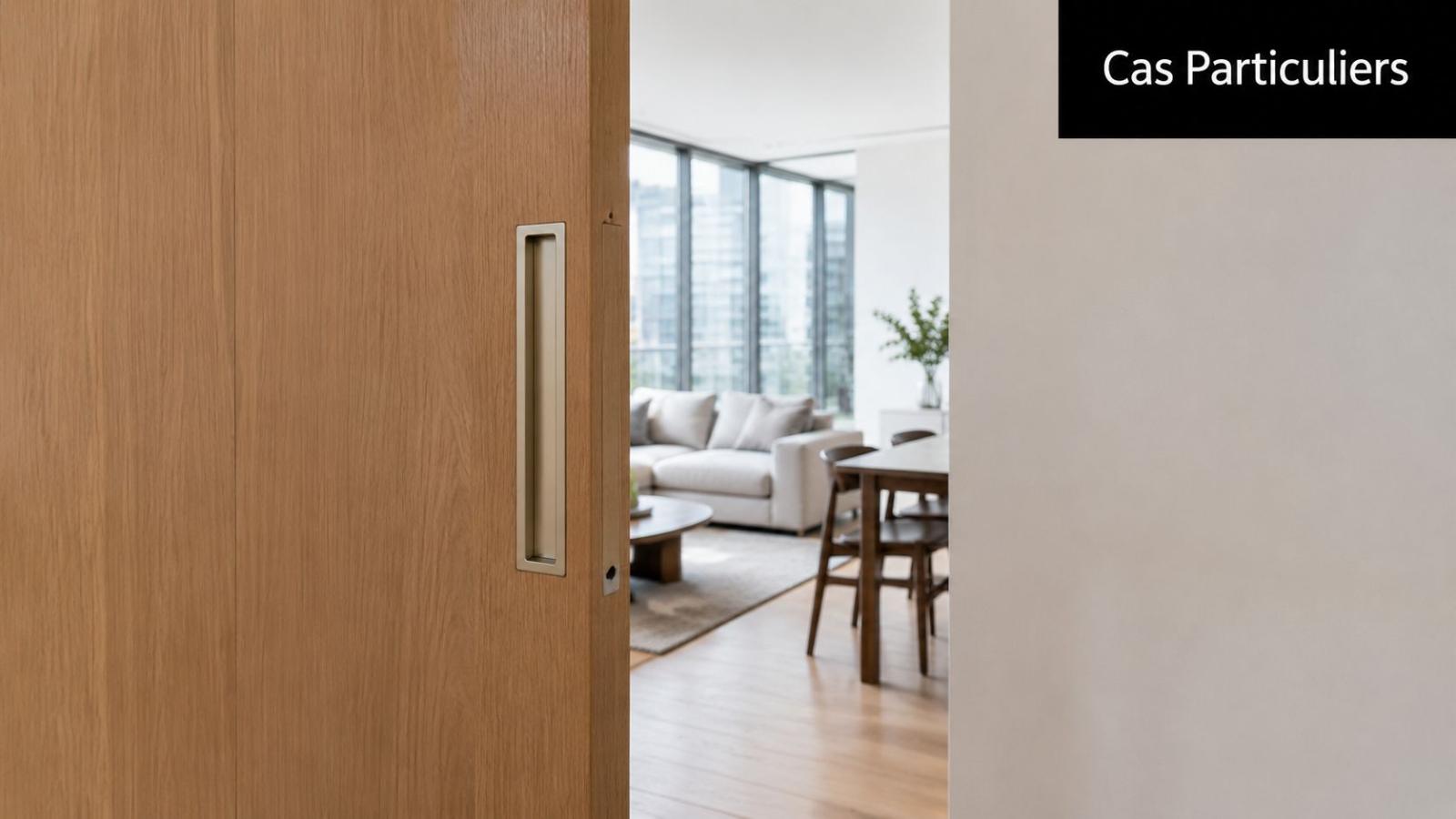
In a renovated downtown condo, a sliding door doesn’t offer the same grip as a hinged door. In a house in Westmount or an old apartment on the Plateau Mont-Royal, you’ll also come across out-of-format doors, thick moldings, or partial replacements where the new hardware has to deal with an old preparation.
Sliding doors
For sliding doors, a height of 90 to 105 cm is typical, with a possible adjustment around 85 cm for wheelchair users, according to this guide dedicated to the height of sliding door handles.
This nuance is very important for light renovation work. On a sliding door, a recessed handle that is too high gives an unnatural grip. Too low and you have to break your wrist or pull from a weak position.
Older doors, heavy doors, special users
On a heavy or heritage door, height is only part of the equation. Leaf weight, threshold friction and latch alignment all influence the feel of the door.
Here are a few useful pointers:
- Older home. We often keep a visual line consistent with the other doors, but never at the expense of comfort.
- Children’s door or family use. Some interior accesses can be adapted, as long as this does not interfere with the main use of the dwelling.
- Seniors and grip limitations. The lever almost always wins out over the button.
- Exterior door in winter. A frozen handle, a stiff bolt or a poorly chosen electronic lock can make even a good height less useful.
In cold Montreal, the best handle is the one you can operate with numb fingers, thin gloves and a door that’s worked a little.
For intelligent installations, models like the Schlage Encode can work well in residential applications when installed on a stable, well-fitting door. Conversely, on an old door that’s already rubbing, adding electronics without correcting the basic mechanics rarely produces good results.
When to call a professional locksmith in Montreal
Measuring a handle is accessible. Repairing a steel door, realigning a multipoint lock or correcting a non-conforming common access is something else entirely.
In the field, do-it-yourself solutions go wrong in a few specific cases:
- Metal or fiberglass door. Drilling is definitive. A dimensional error leaves visible holes.
- Quality hardware. On Abloy, Medeco, Schlage or Corbin Russwin, poor installation can damage an expensive mechanism.
- Commercial door. If the door closer, panic bar, electric strike or access control are at fault, the whole system needs to be treated.
- Rental building or public access. Whenever accessibility, liability or code issues are at stake, it’s best to get the job done right the first time.
In Greater Montreal, this is as true for a triplex in Ahuntsic as it is for a business in LaSalle or an office in Anjou. Old doors are rarely straight, frames have moved, and Quebec winters accentuate misalignments.
A professional locksmith provides more than just installation. He checks height, force, clearance, lever return, bolt alignment and compatibility between lock and door. This is especially important if the installation must meet accessibility practices, RBQ expectations or fire safety requirements in a commercial building.
If the situation is urgent, you also need someone who can intervene quickly, with the right parts in the vehicle, as with an emergency locksmith in Montreal.
Need immediate assistance with a poorly positioned handle, a bad lock or a commercial door in need of repair? Lock Aid Serrurier Montréal is a BSP Certified (#20073700) service, with police security screening, bilingual French-English team, 24/7 Mobile Service, and over 20+ years of professional experience on Montreal real estate, from Westmount to Montreal North. Our technicians cover the Greater Montreal area with a 20-Minute Response Time for urgent calls. Contact Lock Aid Serrurier Montréal for a professional estimate or quick repair.