
You might be looking at a drawer filled with passports, jewelry, copies of documents, USB drives, and a little cash. The real issue isn’t just locking these items away. It’s protecting them without letting everyone know where they are.
In Montreal, this question comes up often in a wide variety of contexts. Whether it’s a condo on the Plateau Mont-Royal, a house in Westmount, a duplex in Ahuntsic, a commercial space in Anjou, or a small apartment building in Saint-Léonard, there’s no one-size-fits-all solution. A wall-mounted safe can be an excellent solution, but only if the wall, the intended use, and the installation are all compatible.
As a locksmith with over 20 years of field experience, I can say this with certainty: the built-in safe that looks unobtrusive on a product sheet isn’t always the right choice for a building in Montreal. And in many cases, the wall itself makes the decision for you.
Why Choose a Wall-Mounted Safe in Montreal
A wall-mounted safe is appealing for one simple reason: it blends into the decor better than a freestanding safe.

In a condo on the Plateau or an apartment in LaSalle, space is at a premium. In a house in Westmount, discretion matters even more. Many homeowners don’t want a large, visible cabinet in a closet or basement. They want a built-in solution that’s harder to spot and more difficult to quickly access.
The concept is not new. The idea of protecting valuables in a locked container dates back a long way in history. A historical overview notes that the first wooden security chests date back to the 15th century B.C. and that safes are used to protect valuables from theft or accidental destruction, as noted in the history of the safe on Wikipedia.
What really appeals to Montreal homeowners
In practice, requests are often similar.
- Sensitive documents such as passports, legal documents, contracts, or digital backups.
- Items of great personal value, such as family heirlooms, watches, or keepsakes.
- A discreet solution for situations where the homeowner doesn’t want a safe to be visible as soon as the closet is opened.
- After a break-in, when the person wants to quickly fix a security flaw that has been identified—often following a break-in in Montreal.
A visible safe draws attention. A safe built into the structure forces an intruder to work harder, longer, and often from a less advantageous position.
Why Montreal is changing the way we think
Montreal’s housing stock complicates matters. In Montreal North or Ahuntsic, there are many lightweight interior walls. On the Plateau, older triplexes sometimes hide surprises behind the drywall. In Westmount, the more upscale homes often offer more options, but they also feature expensive finishes and restrictions that must not be compromised.
A wall-mounted safe works best when security is designed as an integral part of the building, not as an afterthought. That’s where built-in installation makes sense. It takes advantage of the wall’s structure rather than relying solely on the safe’s own weight.
We serve both French- and English-speaking customers throughout the Greater Montreal area. Our advice is the same in both languages. The right question isn’t just “which safe to buy.” It’s “where, in which wall, and to protect what.”
Understanding Safety Ratings and Classifications
The first point of confusion almost always stems from this. People confuse burglary resistance with fire resistance.
These are two different things. A safe may be adequate against forced entry but offer little protection in the event of a fire. The opposite is also true.

Two separate protections
To put it simply, look at a trunk from two different angles.
| Protection type | What it covers in practice | One to watch |
|---|---|---|
| Burglary | Attempts to force entry, prying, levering, or attacking the door | Strength Certification |
| Fire | Protecting contents during a fire | Estimated duration and type of content |
A homeowner who is primarily concerned with protecting legal documents won’t necessarily choose the same product as a business that needs to secure cash or valuables. That’s why buying on a whim often results in a poor fit.
What the standards mean
In the Quebec and Canadian markets, many retailers and installers rely on European standards. A specialist source indicates that EN 14450 establishes a minimum safety standard with classes S1 and S2, while EN 1143-1 targets higher levels with indicative insurability values ranging from €8,000 for Class 0 to €300,000 for Class 6, as explained in this technical guide on safe materials and standards.
In practical terms, what does that mean for you in Montreal or Laval?
- EN 14450 S1 or S2 is suitable when a high level of security is required, without needing to meet the requirements of the highest resistance classes.
- EN 1143-1 becomes more relevant when the value of the contents, insurance requirements, or commercial use necessitate a higher level of protection.
- The quality of the safe should match the value of its contents, not the other way around.
For an overview of our product lines and possible uses, you can also visit our page on security safes.
What I look at before the spec sheet
First, I look at the actual content. Only then do I look at the rating.
Rule of thumb
: If you don’t know exactly what will go into the trunk, you can’t choose the right class or the right setup.
I also consider the type of lock. A key may be suitable in certain situations. An electronic keypad may be simpler for frequent access. A mechanical combination lock remains a good option when the customer wants to avoid relying on batteries. There is no perfect mechanism. What matters most is a mechanism that aligns with the intended use, the user’s level of discipline, and the installation location.
Choosing the right size and capacity
A trunk that’s the wrong size quickly becomes useless. This is a common mistake.
People often think in terms of “small, medium, large.” You need to think in terms of actual items. Passports. Envelopes. Contracts. External hard drives. Jewelry. Cash. Paper copies. And you need to think about how you want to store them, not just whether you can force them in.
The Trap of the Small, Inconspicuous Safe
An electronic built-in model can offer approximately 5 liters of usable capacity, with interior dimensions of 100 × 245 × 185 mm, as shown in this example of a built-in wall-mounted cabinet. In the photo, it looks like enough space. In reality, this size quickly requires careful sorting.
A small safe is easier to hide. That’s its advantage. But it also forces you to make immediate compromises.
- Documents folded rather than stored flat.
- Access is less smooth when multiple objects are stacked.
- It quickly becomes full as soon as you add several passports or document pouches.
- It’s a bad habit to leave certain items “temporarily” elsewhere because there isn’t enough space.
How to make the right choice
Check the inventory before you buy. Not after.
Start by taking out everything you really want to protect. Then divide it into three groups.
Essential
Passports, certificates, legal documents, digital backups.Sentimental or financial value
: Jewelry, watches, family heirlooms, cash.Occasional
Items we think we want to protect, but that we often use and will eventually leave out.
If your main concern is protecting sensitive paper documents, I often suggest considering fire protection. In that case, a fireproof safe may be a better choice than a simple, discreet built-in unit.
The right volume isn’t the one that sells out today. It’s the one that will still be practical a year from now.
Selection criteria for residential or commercial use
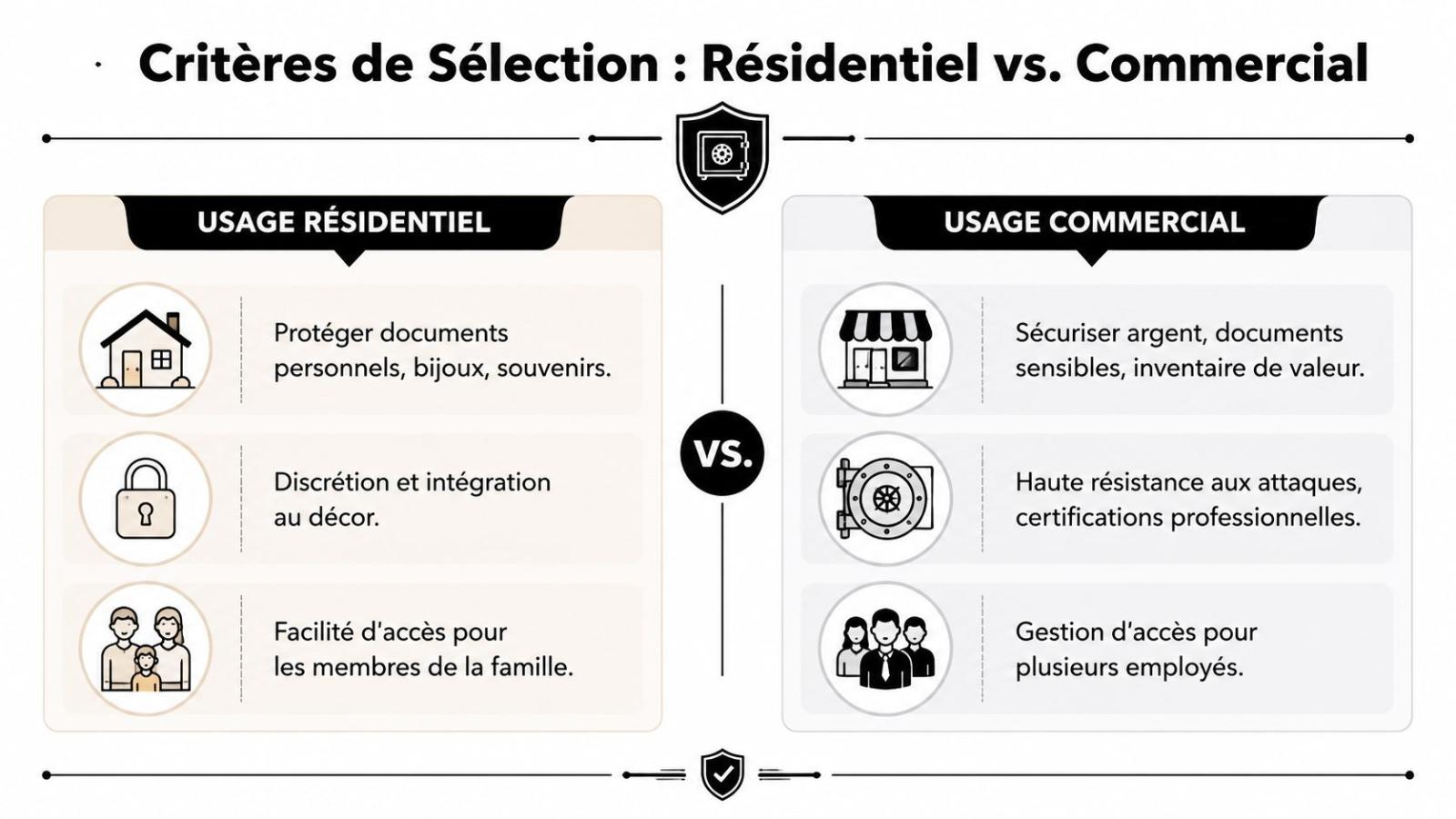
The needs of a family in Ahuntsic and those of a business in Anjou are not entirely the same. The word “security” remains the same. The specifications change.
Residential
At home, the focus is often on discretion and ease of access.
Homeowners often want to protect jewelry, important documents, and sometimes a valuable watch, without turning their bedroom or office into a storage room. In this context, a wall-mounted safe makes sense if the wall is suitable and if access isn’t too frequent.
I often compare this to choosing a good door lock. An Abloy or Medeco cylinder with key duplication control isn’t just for show. It’s designed to limit potential security risks. A wall-mounted safe follows the same logic. We’re looking for comprehensive security, not just a locked box.
Sales
In business, priorities change quickly.
- Access control when multiple people need to be able to open or close the door.
- Traceability, in case the owner wants to know who has the code or who has the key.
- Insurance compliance when required by the insured value or the nature of the documents.
- Uninterrupted operation when the trunk needs to be accessible without slowing down work.
In this context, a well-managed electronic keypad can be more convenient than a key-operated lock. But if staff turnover is high or security procedures are lax, what seems convenient can become a risk.
For business owners who are reviewing their entire physical security system, our commercial locksmith service in Saint-Laurent is often part of the process of evaluating safes, access control, and door hardware.
When a wall-mounted safe isn’t the right choice
An industry expert sums it up well. A wall safe isn’t always the best option if you need frequent access, if the wall can’t withstand being cut into, or if the main risk is opportunistic break-ins rather than prolonged theft, as this guide on concealed wall safes points out.
In many businesses, a freestanding safe that is properly anchored, placed in the right location, and combined with effective access control makes more sense than a built-in safe.
For a residential property, discretion may be the key advantage. For a commercial property, however, it is often the overall sturdiness, functionality, and access control that take precedence.
Installation requirements in Montreal
This is where many projects go wrong. Installing a safe in a wall is not a finishing job. It involves altering the building’s envelope or structure.
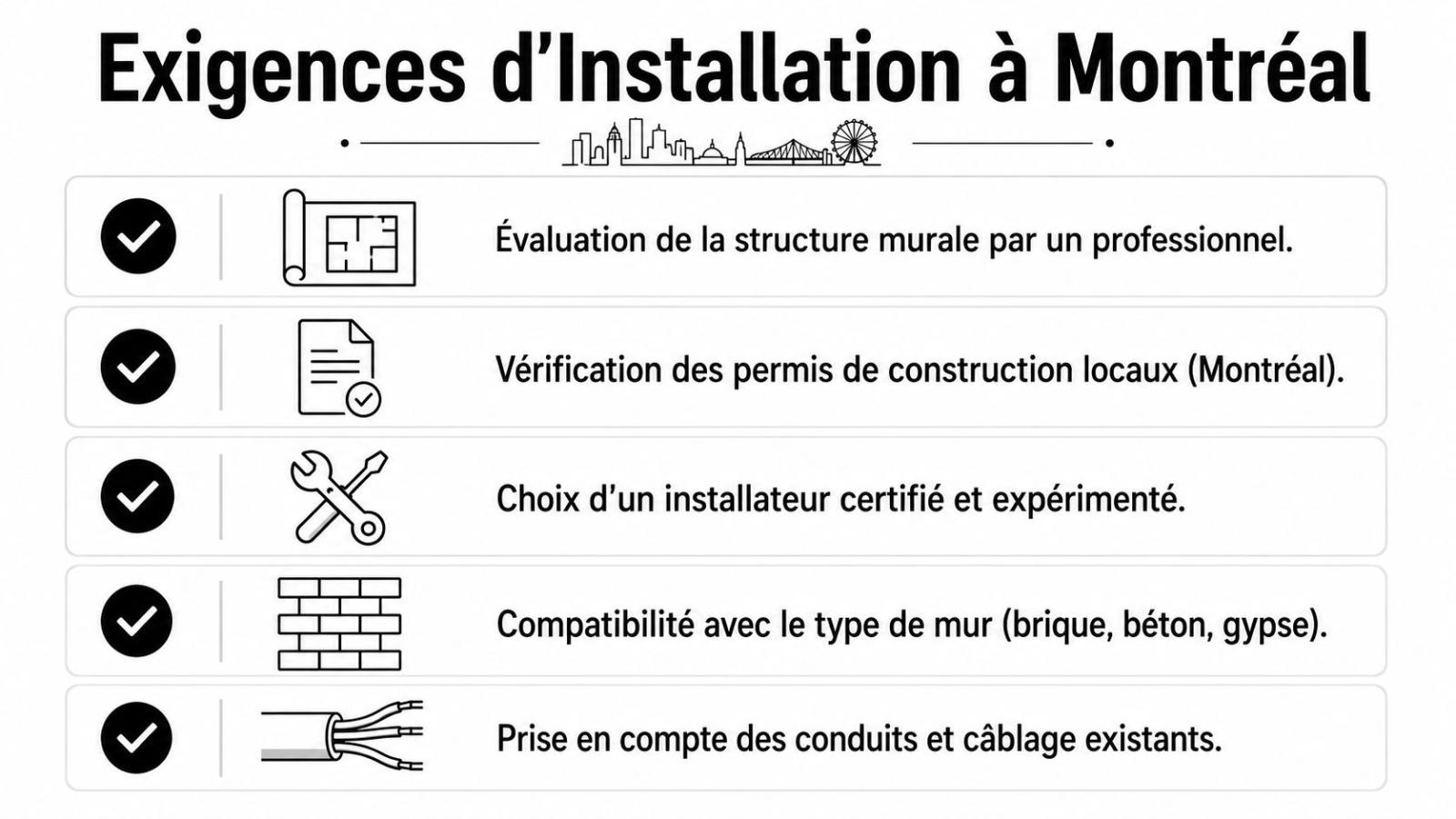
In Montreal, you have to deal with walls that vary greatly from one neighborhood to another: Plateau Mont-Royal, Westmount, Saint-Léonard, Montreal North, LaSalle, and Anjou. The type of wall, the age of the building, and the quality of past renovations completely change the feasibility of the project.
The real question isn’t where you want to put it
The real question for Quebec is this: In what type of wall is installation actually safe? General guides mainly discuss load-bearing walls, masonry, and anchoring, but they do not adequately address common situations in Montreal, such as lightweight partitions, condominium restrictions, and the risk of damaging insulation or the vapor barrier, as this guide on installing a safe points out.
In a new condo, the wall you’ve chosen is often just a simple partition. In an older triplex, there may be cavities, utility lines, or poorly documented past repairs. In a renovated home in Westmount, the finishing work is sometimes more expensive to redo than the installation itself.
What works well
The cleanest and most consistent installations are generally achieved in walls that provide substantial mass and stability.
- Concrete or suitable masonry, provided the thickness and composition allow for secure anchoring.
- A dry location to prevent the trunk and its contents from being exposed to hidden moisture.
- A discreet yet accessible area so that users don’t hesitate to use it properly.
- Preliminary inspection of the wall to identify wiring, plumbing, ducts, and structural constraints.
A visual demonstration can sometimes help clarify the challenges involved in installation and mounting.
What often goes wrong
Mistakes always happen again.
| Error | Likely consequence |
|---|---|
| Cutout in a lightweight partition | Low tear resistance |
| Ignore the vapor barrier or insulation | Moisture and wall performance issues |
| Install without confirming co-ownership | Disputes with the union or obligation to restore the property |
| Choose the location before assessing the structure | A project doomed from the start |
A safe built into the wrong wall may be less secure than a freestanding safe that is properly secured and installed in the right location.
When a professional is not optional
In Montreal, there are too many variables to wing it. Wall type, wiring, plumbing, insulation, firewalls, condominium bylaws, site access. This is even more true in multi-unit buildings in Ahuntsic or Montreal North, where a mistake can affect a shared wall, a duct, or a finish that doesn’t belong entirely to you.
This is where a BSP-certified locksmith (#20073700) with security clearance and on-site experience becomes essential. We provide bilingual service in French and English, with a very practical understanding of the building. A recessed installation project is nothing like a simple replacement of a Schlage, Weiser, Assa Abloy, Corbin Russwin, Dorex, or LCN cylinder. Here, we’re dealing with both physical security and the building structure at the same time.
Costs, Maintenance, and Troubleshooting for Your Safe
The true cost of a safe is never limited to the safe itself. It includes the product, the site assessment, installation, and after-sales service in case of any issues down the line.
An inexpensive wall safe that is poorly chosen or improperly installed can end up costing a lot in wall repairs, finishing work, or emergency opening. On the other hand, a high-quality, properly installed safe will last a long time with little maintenance.
Simple maintenance that saves a lot of service calls
A safe doesn’t require a lot of maintenance, but you shouldn’t neglect it for years on end.
Batteries for electronic models
: Replace them before they run low, not after they die.Mechanism and Door If the door becomes difficult to open, do not force it. Unusual resistance is often a sign of a problem that is getting worse.
Ambient humidity
In some basements or exterior walls, watch for signs of indirect moisture.Access Management Maintain a clear system for keys, codes, and authorized personnel.
What to do if the trunk won’t open
Do not force the lock. Don’t drill anything. And don’t try any “online methods.”
The right approach depends on the mechanism. A broken key, an electronic keypad with no power, a live door, or an internal problem are not handled in the same way. A locksmith experienced in opening safes will first look for the least destructive method.
Properly cleaning a trunk requires protecting two things at once: the contents and the trunk itself.
For emergencies, our mobile units serve Montreal, Laval, Brossard, Longueuil, and Terrebonne, offering 24/7 service and an emergency response time of 20 minutes for priority calls related to lockouts or urgent repairs.
Legal considerations and the master locksmith’s opinion
In most residential cases, the legal question isn’t “do you have the right to install a safe,” but rather “do you have the right to modify that wall.” In a condo or co-ownership building, the internal rules often take precedence over your intentions. If you cut through a wall without approval, the issue is no longer just safety. It also involves compliance and restoration.
In a commercial setting, it is also important to consider insurance, internal liability, and—depending on the environment—consistency with the site’s other security measures. A wall-mounted safe does not replace effective access control, sturdy doors, or appropriate hardware. It is an additional component of the overall system.
For homeowners who also need secure storage for firearms, the requirements are different from those for a document safe. In this case, they should look for a specialized solution, such as a gun safe.
My opinion as a master locksmith is simple. A wall-mounted safe is a very good solution when three conditions are met.
- Proper use, meaning well-defined content.
- The right wall, meaning it’s actually technically feasible.
- Proper installation means a clean and safe job.
If even one of these conditions is not met, it’s best to rethink the plan. A poorly placed safe provides only a false sense of security. A well-chosen and properly installed safe, on the other hand, serves as a true layer of protection.
Need a professional assessment for a wall safe project, a stuck safe door, or emergency service after a break-in? Lock Aid Locksmith Montreal is a BSP Certified (#20073700) service, bilingual, with over 20 years of experience, 24/7 Mobile Service, and a 20-minute response time for emergency calls in Montreal, Westmount, Plateau Mont-Royal, Anjou, Saint-Léonard, Montreal North, LaSalle, Ahuntsic, and Greater Montreal. Call for a professional estimate and honest advice on what works, what doesn’t, and when installing a wall safe is truly the right choice.