On this page
You’re often faced with the same scenario. The patio door closes, but doesn’t lock. Or it locks when it’s ajar, then refuses as soon as you push it fully into the frame.
In Montreal, I see this everywhere, from Westmount to Saint-Léonard, via Plateau-Mont-Royal, Ahuntsic, Anjou, Montréal-Nord and LaSalle. The common reflex is to buy a new lock right away. This is often the wrong first decision.
On a sliding door, the problem often comes from the adjustment, the track, the strike plate or seasonal misalignment. Freezing, thawing, humidity and temperature changes make the door, hardware and frame shift. A patio door lock that’s hard to operate isn’t automatically a lock that’s finished.
As a locksmith in Montreal, bilingual FR/EN, holding BSP permit #SER 20073700 with a full police check, I’ve been handling this kind of call for over 20 years. The right order is simple. Diagnose first. Repair if possible. Replace only when the part is really at fault.
Diagnosing the problem with your patio door lock
When a patio door jams in Anjou or doesn’t close properly in Westmount, I always start by separating the symptom from the real fault. A lock may appear to be at fault when the bolt is simply too high or too low in front of the strike plate.
The useful point to keep in mind is the lifespan of the unit. In Quebec, a quality patio door generally lasts 20 to 30 years, according to this benchmark on the life of a patio door (opens in a new tab). After that, the overall wear and tear of the panel, rollers and hardware becomes a real factor.

Three tests to avoid a bad purchase
First test. Open the door and turn the handle or latch. If the mechanism moves in and out correctly with the door open, the lock may not be the main problem.
Second test. Gently close the door without forcing the handle. Look to see if the bolt is facing the strike plate. If it rubs, catches or misses its entry point, you often have an alignment problem.
Third test. Check sliding. A door that doesn’t slide properly in its track, or that drags or tilts, puts stress on the lock. The latch then becomes hard, even if the internal mechanism is still sound.
Rule of thumb
If it works with the door open but not closed, I suspect the alignment first, not the lock.
Signs pointing to the lock itself
Certain clues point to a real mechanical breakdown:
- Abnormal play in the handle. Handle moves without driving the mechanism.
- Soft locking. Little resistance, then little grip.
- Incomplete bolt. Latch partially extended or returns on its own.
- Fussy cylinder. The key turns poorly, catches or doesn’t always operate the lock.
On many models, the problem can also come from an intermediate part. That’s why, before concluding that a lock needs replacing, you need to think about the strike plate, the corner drive or the door adjustment. The same logic applies to other mechanisms that jam, as in this case of a Weiser lock with an operating problem.
What Montreal weather really changes
In Montreal, the cold stiffens unsuitable lubricants. Moisture swells certain materials around the door. Seasonal cycles move the panel and frame slightly. As a result, a lock may “fail” only in winter or only during wet periods.
I often see this on older doors on the Plateau-Mont-Royal or in Ahuntsic. The customer replaces the handle, then calls back because the real fault was the position of the door on its rollers.
Misreading the problem costs more than a worn lock.
Easy troubleshooting and steps that can save you
If the diagnosis points to soiling, slight rubbing or loose hardware, you can sometimes put the door back into service without heavy disassembly. The important word is gently. A patio door is better corrected by small adjustments than by force.
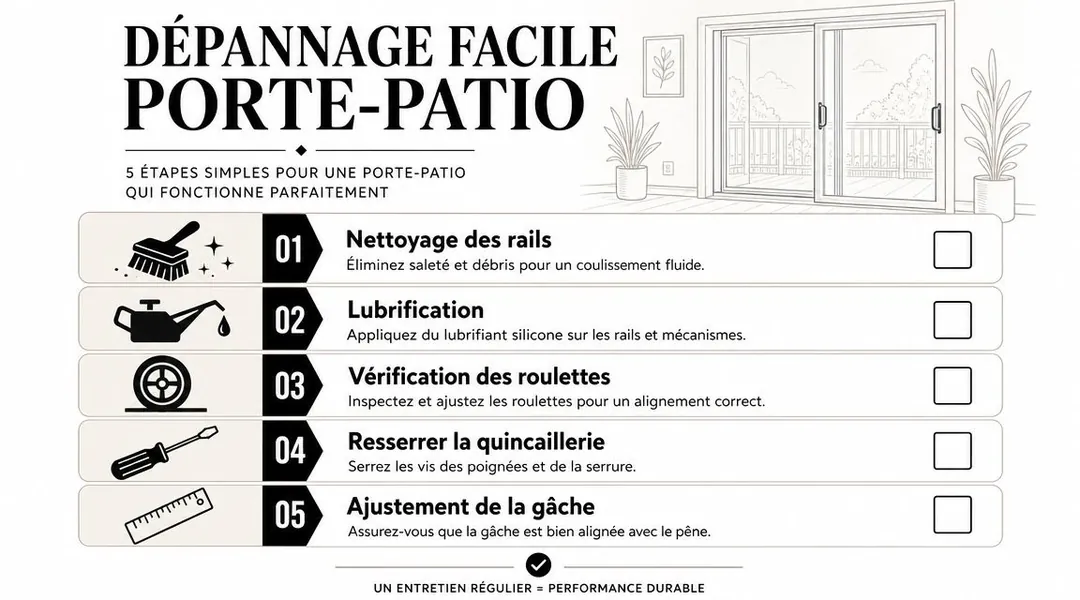
Here’s the most useful visual for clean home repairs.
Simple moves that get real results
Start by cleaning the bottom track. Dust, sand, hair and small debris change the door’s seating. The panel doesn’t sit as well, and the latch doesn’t sit properly in front of the strike plate.
Then tighten the visible screws on the handle and hardware. A slightly loose handle is sometimes enough to create the feeling of a faulty lock.
Finally, lubricate the right spot. The rail and moving points like a suitable silicone lubricant. Greasy products that leave a sticky film often end up trapping dirt. When this builds up, the door slides less smoothly and the latch works crookedly.
When the problem comes from somewhere other than the lock
A much overlooked angle is the actual diagnosis before replacement. French door systems use several interconnected parts, such as the angled lock strike or the corner drive, which explains why simply changing the handle doesn’t always solve the problem, as shown by this category of French door accessories at Richelieu (opens in a new tab).
In the field, I’ve also seen people forcing an inside handle that doesn’t lock properly. This is rarely a good idea. If you’ve already experienced this type of symptom on other doors, the same principle of caution applies to an interior door handle that’s stuck.
Before going any further, this video demonstration helps to visualize common control points.
What not to do
- Force the key. If the cylinder resists, you risk breaking the key or damaging the barrel.
- Twist the handle. The classic result is warped hardware.
- Unscrew at random. On some doors, you disturb more than you repair.
- Buying a lock that “looks the same”. Looks are never enough on a patio door.
If a door only jams on certain days, especially after a change in temperature, I first check the door movement in its frame.
DIY lock replacement guide
When the mechanism is really faulty, replacement becomes logical. Here, the typical error is not in the screwdriver. It’s in the measurement.
On a patio door, the existing geometry must be respected. A common model shown in Canada is 7/8″ wide, 2″ high, 5/8″ centre-to-centre (C-C) and 3/16″ in diameter, and the correct method is to measure panel thickness, fastener centre-to-centre and bolt travel before buying, as shown in this Richelieu datasheet for a foot-operated patio door lock (opens in a new tab).

Measurements to take before buying
Take three measurements, and take them twice.
Panel thickness
The cylinder or lock must match the actual door thickness. If not, you’ll get play or an abnormal protrusion.Screw spacing
5/8″ is often found on many patio door hardware products in Canada. “Often” does not mean “always”.Bolt travel
Check how far the bolt needs to extend to enter the strike plate cleanly.
Recommended order of work
First remove the handle and the old mechanism without tearing the panel finish. Set the screws aside in order, because some look alike but don’t do the same job.
Then dry-fit the new lock. Before tightening completely, check that the bolt lines up with the strike plate. This is where many DIY replacements go wrong.
Finally, test with the door open, then closed. If the lock works open but rubs closed, the installation isn’t finished yet. The alignment needs to be redone.
What works and what wastes time
The right reflex is to bring the old part and your measurements when you shop. The wrong reflex is to look for a “standard sliding door lock”.
For the cylinder, the same principles of compatibility apply. If you want to understand how the part fits in with the rest of the mechanism, take a look at this guide to door cylinders and their functions.
A poorly measured new lock sometimes locks worse than an old, worn lock.
If you’re in LaSalle or Ahuntsic and the replacement goes wrong, a mobile service like Lock Aid’s can take over the adjustment on site without necessarily changing the whole set.
Improve your security by choosing the right lock
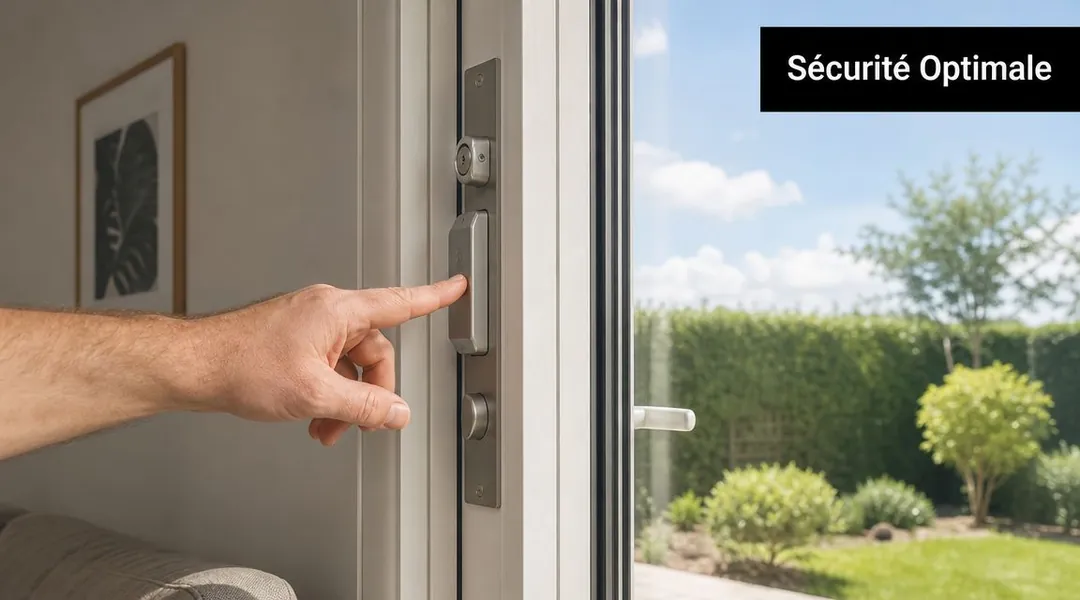
Replacing a patio door lock also means correcting a known weakness. A sliding door is practical, but it exposes a long moving panel. If the main latch is average and the track is loose, the whole assembly becomes more vulnerable.
The most reliable approach remains mechanical. To reduce the risk of the door being pried open, the strongest installation rests on three points: correct alignment of the track, a well-adjusted main lock, then the addition of a security bar or a secondary lock.
What type of lock to choose
The choice depends on daily use, the level of risk and the condition of the door.
| Option | Common use | Practical limits |
|---|---|---|
| Equivalent replacement lock | When you want to get back to the way things were | Does not greatly improve resistance if door remains flexible |
| Multipoint system | When the door is still structurally sound and well aligned | Requires precise compatibility |
| Secondary lock or bar | When you want clear, simple redundancy | Less elegant, but often very effective |
Brands and real trade-offs
For serious residential security, Abloy and Medeco are sound choices when you want a cylinder that’s more resistant to picking and drilling, with the important advantage of restricted key control. In practice, it prevents casual copying at the hardware store.
For a good balance between budget, parts availability and everyday use, Schlage and Weiser remain sensible options. If the job involves a building or a heavier door, the logic changes and we look more at solutions from manufacturers such as Assa Abloy, Corbin Russwin, Dorex or LCN, depending on the building.
For readers who compare key control levels and security cylinders, this point ties in well with the world of Mul-T-Lock solutions for residential and commercial doors.
What I recommend in the Montreal climate
In Saint-Léonard, Montréal-Nord or near the river, I avoid low-end choices on a door that’s very exposed. Cold, condensation and corrosion quickly punish lightweight parts.
I prefer a lock that’s well adapted to the door model, followed by a simple mechanical reinforcement. A good patio door lock is more than just a cylinder. It’s the alignment, the strike plate, the track and the redundancy.
Costs and when to call a certified locksmith in Montreal
The real calculation isn’t just the price of the part. You have to consider the risk of breaking something else, the time lost, and the final level of security.
If the door closes poorly but can still be adjusted, an adjustment may be enough. If the mechanism has seized, a key has broken, the handle spins freely or a multi-point system responds poorly, the job becomes more technical. At that stage, forcing things often damages the panel, the strike plate or the frame.
The right decision criteria
Here’s my simple checklist in the field:
Reasonable DIY
Cleaning, retightening, light lubrication, visual check of the alignment.Recommended professional service
Persistent misalignment, lock jamming despite open door, damaged cylinder, unknown internal parts or hard-to-identify old hardware.Clear emergency
Door no longer secure, access impossible, key broken, lock compromised after forced entry attempt.
Why a certified locksmith changes the outcome
In Montreal, you need someone who knows local residential doors, their seasonal variations and the hardware found in condos, duplexes and rental buildings. A locksmith holding BSP permit #SER 20073700 also works with a diagnostic approach. That’s often the difference between a clean repair and an unnecessary replacement.
Local context also counts. In Westmount, older doors sometimes require the preservation of existing hardware. In Anjou or LaSalle, the problem is often more functional than heritage-related. In Ahuntsic or Montréal-Nord, we often come across doors that have already received partial repairs and mismatched parts.
When several small anomalies add up, the lock becomes the visible symptom of a larger problem.
When to call right away
If you’re outside and the door refuses to lock, don’t try ten times in a row. If the handle is showing signs of weakness, each attempt may worsen the internal play.
In this case, it’s better to call an emergency locksmith who serves your area. During business hours, you can use an emergency locksmith service in Montreal. Our reality in the field is the same for French- and English-speaking clients across Greater Montreal. You need to secure the opening, protect the door, then replace only what needs replacing.
Need help now with a patio door that won’t lock in Westmount, the Plateau-Mont-Royal, Anjou, Saint-Léonard, Montréal-Nord, LaSalle or Ahuntsic? Lock Aid offers a fully bilingual service, with BSP permit #SER 20073700, for emergencies across Greater Montreal.
Call for a professional estimate, a clear assessment of whether you need an adjustment, a repair or a replacement, and mobile service during published business hours, with no unnecessary work.