On this page
- Introduction: Installing a door handle is more than just a question of aesthetics
- Door handle height regulations in Quebec
- How to measure and choose the right handle for your door
- Specific requirements: residential, commercial and accessibility
- Installation tips and common mistakes to avoid
- When to call a professional locksmith in Montreal
For a residential door handle in Quebec, there is no single height that automatically applies to every door. A replacement often follows the existing bore and the ergonomics of the door. Barrier-free paths and certain regulated buildings may have specific accessibility requirements that must be confirmed for the building and by the authority having jurisdiction.
You may be renovating a condo on the Plateau-Mont-Royal, replacing an old handle in a house in Anjou, or correcting a poorly closing door in a duplex in Ahuntsic. In practice, the height of a door handle is never just a finishing detail.
A handle that’s too low is tiring to use. A handle that’s too high is less comfortable for a child, a senior or a tenant with reduced mobility. And in a business in LaSalle, Saint-Léonard or Westmount, poor positioning also complicates the choice of closer, lock and sometimes exit device.
As locksmiths who’ve been working in the greater Montreal area for over 20 years, we see the same mistake coming back. People choose the style first, then try to fit the mechanics into the door. We need to do the opposite. Start with the function, the dimensions, the type of lock, then choose the finish.

There’s also a useful bit of history. In 1848, Osbourn Dorsey patented the first modern door handle, as recalled in dormakaba’s history of door handles (opens in a new tab). Since then, the principle has remained the same. A good handle must be reliable, well positioned and compatible with the mechanism it controls.
Our Montreal reality adds two very concrete constraints. The climate wears down springs, finishes and electronic components. And the housing stock is very varied, from old plexes in Montréal-Nord to renovated houses in Westmount, rental units in Anjou and small businesses on the Plateau.
A well-installed door handle is hardly noticeable. A poorly installed handle is felt every day.
If you’d like to find out who works on this type of hardware in the area, you can check out our bilingual Montreal locksmith profile. We serve both English-speaking and French-speaking customers throughout the Greater Montreal area.
Introduction: Installing a door handle is more than just a question of aesthetics
In houses, condos and small rental buildings, the door handle is often chosen at the end of the construction phase. This is a classic mistake. A handle influences latch alignment, hand comfort, accessibility and even the longevity of the lock.
In Montreal, I often see this scenario. The owner replaces an old plate trim with a more modern model, without checking the old drillings. As a result, the screws don’t go in the right place, the plate doesn’t cover the marks properly, and the door closes crookedly.
What most people discover too late
In a Rosemont plex or a neighbourhood shop in Ahuntsic, the right question isn’t just “Which handle looks good?” The real question is this. Is the handle right for the door, for daily use, for the type of lock and for the applicable rules?
For a simple interior door, you can aim for a sober, durable installation. For an entrance door or commercial door, you need to think in terms of resistance, compatibility with the cylinder and the wear and tear created by passage.
- Light residential: Schlage or Weiser hardware often does the job very well if the measurements are right.
- High-security residential: an Abloy or Medeco cylinder becomes relevant when controlling key copies counts.
- Commercial: Dorex, LCN, Assa Abloy or Corbin Russwin are better suited to heavy doors and repeated use.
What really works in the field
Lever handles are generally easier to use on a daily basis than round knobs. On interior doors, a well-fixed plate is more forgiving of old marks than a small rose. In rental properties, mechanical simplicity is often the best option when several occupants use the same door.
Rule of thumb
A nice-looking handle on a bad lock almost always ends up as a service call.
Door handle height regulations in Quebec
In Quebec, handle height and operating hardware depend on the building, the door’s use and the rules that apply to the project. On an existing residential door, the bore and consistency with the other doors often guide replacement.
For a barrier-free path or regulated building, consult Quebec’s building accessibility guidance (opens in a new tab) and have the project-specific requirements confirmed by the authority having jurisdiction.
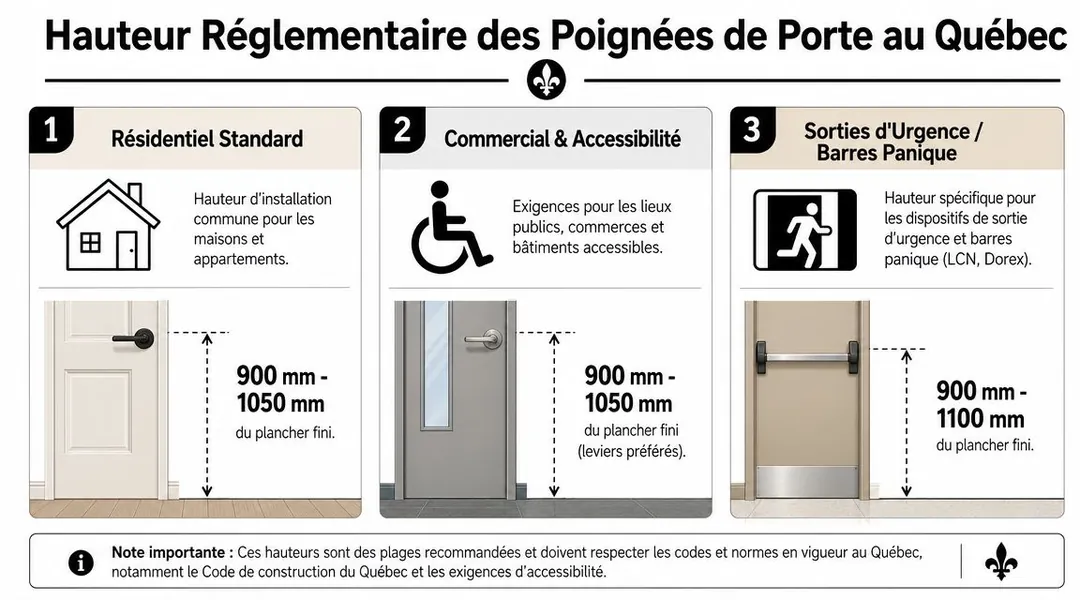
A suitable position reduces awkward movements, makes the door easier to open and avoids improvised installations sometimes found after a quick renovation.
In Montreal, this deserves particular attention in homes occupied by families, seniors or people with reduced mobility. The goal is to choose hardware that is easy to grasp and suited to the occupants, without presenting an ergonomic preference as a universal rule.
The right range for the context
Here’s a simple guide to reading the terrain before drilling.
| Type of use | Installation reference | Key considerations |
|---|---|---|
| Existing residential door | Existing bore and occupant comfort | Consistency with other doors, natural grip and hardware compatibility |
| Residential with an accessibility goal | Confirm for the project | Lever handle and occupant needs; check the applicable requirements |
| Commercial or public use | Confirm for the building | Check the complete door, lock, closer and applicable requirements |
| Emergency exit and specialized hardware | Depends on the door and occupancy | Check the complete assembly, not just handle height |
Why the simple average is not enough
In the field, I don’t recommend installing “roughly in the middle”. It often leads to inconsistent doors in the same home. In a duplex in Montréal-Nord, we sometimes see a bathroom door with a lower handle than the others, simply because an old hole was already there.
What works best is to measure from the finished floor, not from plywood or flooring that hasn’t yet been installed. In a renovation in Westmount or a commercial space in LaSalle, this nuance eliminates the need to redo the installation after the fact.
For emergency exits, you also need to think in terms of the complete system. A panic bar, an LCN or Dorex door closer, and the useful passage width must work together. If you’re interested in this subject, it’s a good idea to consult the rules for emergency exits in Quebec.
A handle installed at the right height, but on a poorly prepared door, is still a poor installation.
How to measure and choose the right handle for your door
Replacing a door handle often comes down to three measurements. If they’re right, installation goes quickly. If one of them is wrong, the handle wobbles, jams or wears out the lock.
For plate-mounted handles, the key measurements are the mounting centres, the handle-to-lock centres and the spindle or square size. These dimensions vary with the lock and existing hardware. Measure the door and check the manufacturer’s specifications before ordering rather than assuming a universal size.
The three measurements to take before buying
- Mounting centre distance: measure the distance between the top and bottom screw holes if you have a plate-mounted handle.
- Handle-to-lock centre distance: measure between the centre of the square of the handle and the centre of the key hole or cylinder.
- The square: measure the spindle that operates the mechanism and choose hardware compatible with the existing lock.
Incorrect handle-to-lock spacing can make the mechanism bind. A handle that resists or does not return properly can wear the return spring, drive the latch out of alignment and eventually jam the door. A diagnosis should confirm the cause before replacement.
Which handle to choose
For an interior door in a condo or house, Schlage and Weiser offer easy-to-maintain options. For a high-traffic area in Saint-Léonard or an office building, a commercial range like Dorex generally holds up better over time.
If the door leads outside, also check compatibility with the cylinder, the weatherstripping and exposure to frost. To see the main families of models, you can consult this guide to exterior door handles.
On an old door, the most expensive new handle won’t correct an incorrect centre-to-centre distance. Measurement comes before finishing.
Specific requirements: residential, commercial and accessibility
A bedroom door in a Westmount home doesn’t have the same requirements as a commercial entrance in Anjou. The right choice depends on the passageway, the level of security required and accessibility requirements.
In the residential sector, we seek balance
In a house or condo, you want a handle that’s reliable, pleasant to grip and suited to the style of the door. On interior doors, a lever handle is often more practical than a round knob. On front doors, the real point of security often lies more in the cylinder and deadbolt than in the handle itself.
For Montreal rental-property owners, accessibility deserves special attention. Lever handles are often easier to operate than round knobs. Required dimensions and clearances depend on the building and door; consult Quebec’s building accessibility guidance (opens in a new tab) and have the applicable requirements confirmed before work begins.
In commercial settings, the handle is only one part of the system
In a business in Ahuntsic, LaSalle or on a Plateau thoroughfare, you never choose the handle alone. You have to look at the door as a whole.
- Standard commercial door: sturdy handle, compatible lock, protective plate if the leaf is already worn.
- Emergency exit: panic bar and compliant hardware, often with LCN, Dorex or Corbin Russwin components.
- Buildings with controlled access: reader, electric strike, door closer and handle must be designed as a whole.
For this type of configuration, door access control solutions often become more relevant than a simple handle replacement.
In rental buildings in Montréal-Nord or Saint-Léonard, the lever handle is often the most logical choice. It’s easier to use with full hands, better suited to accessibility and more in line with real-world use.
Installation tips and common mistakes to avoid
A door handle may seem quick to install, but there are many details that make the difference between a clean installation and a repair that has to be redone in a few weeks’ time.

The first mistake is screwing it in before testing the mechanism off the door. The second is overtightening. Crushed trim works poorly, and the handle return gets stiffer almost immediately.
Steps to avoid problems
- Check latch direction: before final assembly, make sure the latch bevel matches the door closing direction.
- Keep it level: a slightly crooked handle is easy to see, especially on a long plate.
- Tighten without forcing: too much torque distorts the plate or compresses the mechanism.
- Test with the door open: operate the handle several times before closing the door.
- Respect the Montreal cold: on a smart lock like a Schlage Encode, the choice of batteries and the seal around the door count for a lot in winter.
For a visual demonstration of the assembly principle, this video helps you to see the basic points before taking out the drill.
What doesn’t work well in Montreal
Improvised installations on a door swollen with moisture. Decorative handles on a tired lock. Electronic models installed without thought to cold exposure, weather-stripping and bolt alignment.
When an interior handle locks irregularly, it’s not always the handle that’s at fault. The lock body, the latch, the strike plate or the door clearance may be the cause. If you have this symptom, this case of an interior handle that locks often looks like what we see in the field.
When to call a professional locksmith in Montreal
Some repairs are reasonable to do yourself. Others aren’t. If the handle spins freely, the latch stays stuck, or the door won’t open even with a working key, you need to stop before you damage the lock or the door edge.
Broken springs, loose screws and jammed mechanisms are common symptoms of a faulty handle. In Montreal, cold, moisture and a misaligned door can aggravate the problem. Inspecting the handle, latch, lock and strike helps identify the actual cause.
Signs that justify a call
- The handle doesn’t spring back properly: the return spring is worn or the mechanism is binding.
- The door closes only when lifted: the problem often goes beyond the handle alone.
- Screws no longer align: old drilling, incompatible lock or warped door.
- Bolt remains extended: immediate risk of jamming.
- The electronic reader responds poorly: on a commercial door, you have to check the whole system.
In these cases, the proper intervention is to diagnose before replacing. An experienced locksmith looks at the handle, lock, strike plate, door clearance and frame condition. This is particularly important on commercial doors fitted with closers, access control or heavier hardware.
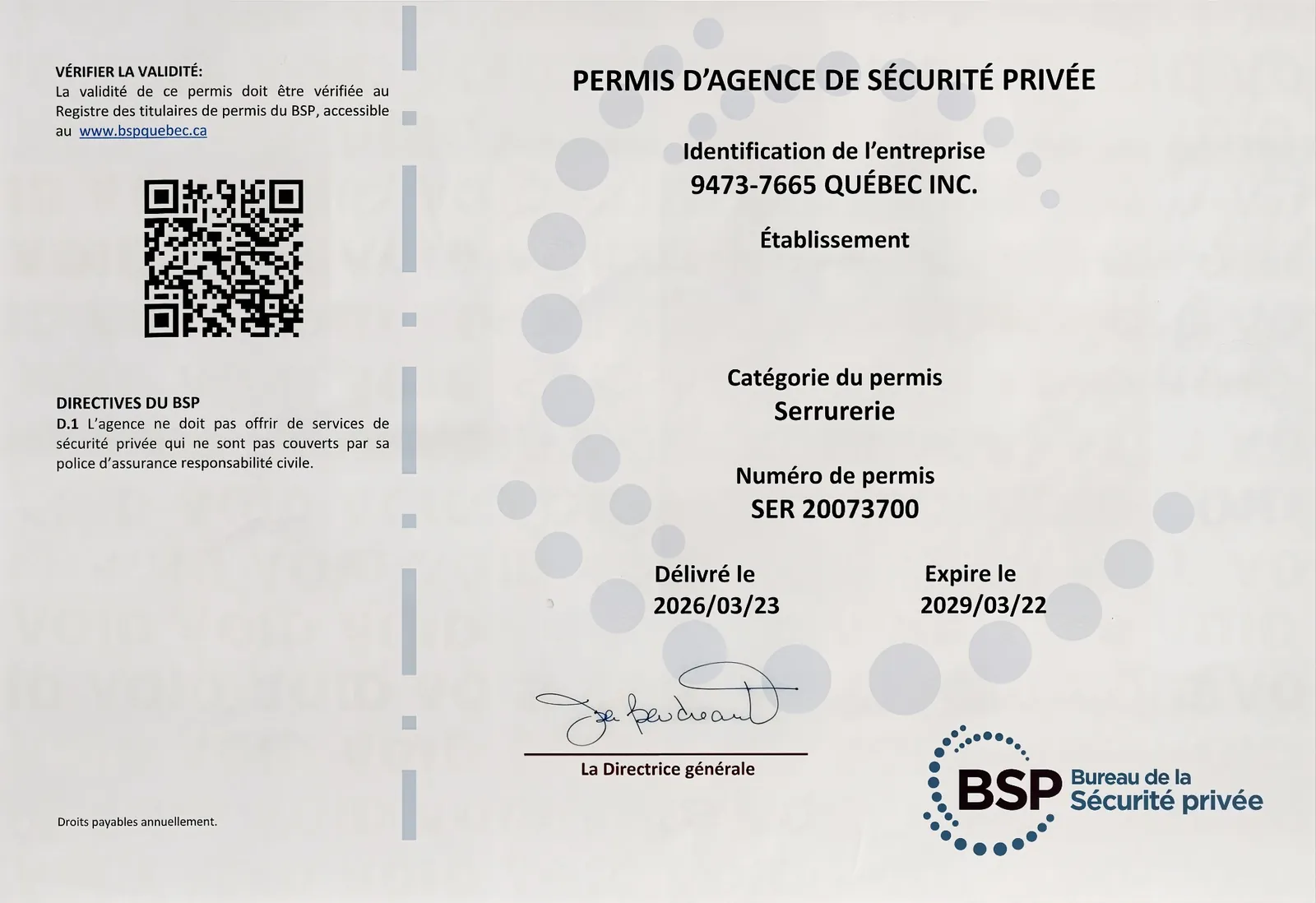
As hands-on practitioners, our approach is simple. Preserve the door first, then replace only what needs replacing. Holding BSP permit #SER 20073700, with over 20 years of experience and a fully bilingual team for emergencies in Montreal, Laval, Brossard and Longueuil, we handle this type of residential and commercial breakdown without turning a faulty handle into an unnecessary full replacement.
Need help with a door handle that’s jammed, misaligned or due for replacement? Lock Aid offers a bilingual mobile service, residential and commercial, throughout Montreal, from Westmount to the Plateau-Mont-Royal, including Anjou, Saint-Léonard, Montréal-Nord, LaSalle and Ahuntsic.
Our technicians work under Lock Aid’s BSP permit #SER 20073700 and travel for emergencies. For an emergency, we confirm an estimated arrival time based on your area. Call Lock Aid at (438) 300-7549 or request a locksmith online for a professional estimate or emergency repair service.